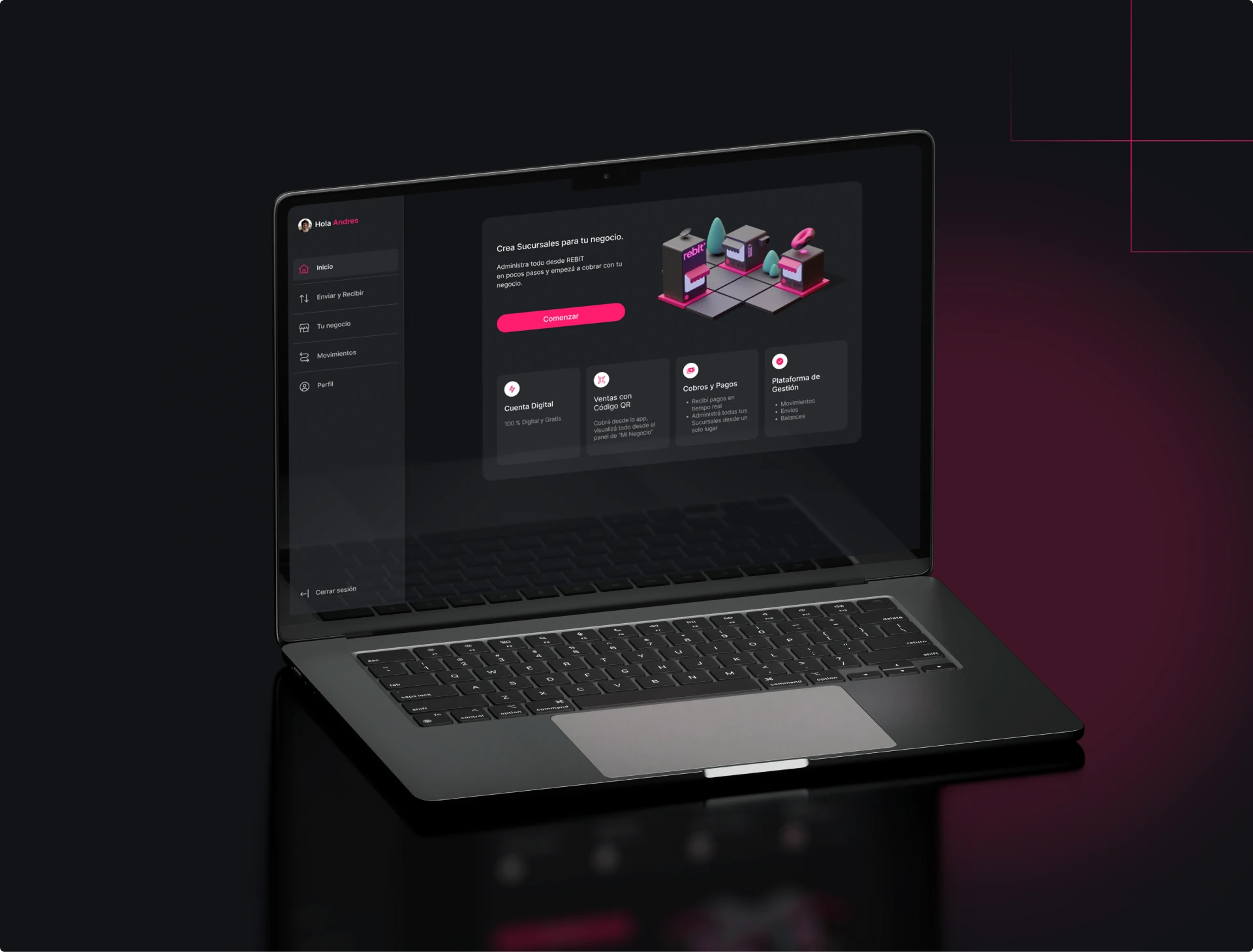
Building the Merchant Side of a Fintech from Zero
Rebit App solved the consumer side of the wallet. Rebit Comercios had to solve the other half — giving merchants a reason to accept it. There was a gap in the market: merchants were being served with generic products, and working side by side with each client let us offer a level of customization nobody else was providing, on a commission structure that also made the product sustainable.
A merchant needs to see money movement clearly, reconcile it against their own sales, and trust a new payment rail enough to put it in front of their customers. I was responsible for building that side of the product from the ground up — the first user flows, the high-fidelity prototypes, and the UI Kits in Figma that kept the system scalable as branches, cash registers, collaborators and commissions were added to the scope.
The infrastructure came with its own constraints. The merchant app ran on RedLink — logic closer to Brubank or Mercado Pago than to a card terminal — while Prisma enabled QR and card payments at the point of sale. TAPI sat on the consumer side, as one more integration for paying bills, and was not part of the merchant's collection circuit. Each provider carried its own tooling and cost structure to evaluate before committing.
There was also an investor dimension: Rebit Comercios needed to be pitchable. The flows had to hold up not just in usability testing, but in a room full of people deciding whether to fund the company's next stage.
I mapped the merchant journey from first contact to daily use — signup, verification, first charge, reconciliation — before designing a single screen. Choosing the payment providers was as much a design decision as a technical one: I evaluated six providers — RedLink, Prisma and Banco de Comercio among them — on viability, tooling and impact on transaction costs, then led the handoff with the engineering team.
The experience didn't end at the screen. By September 2024 I was producing the physical and digital instructions merchants needed to print and display Rebit's QR code at the register — the piece that turned the product into real in-store transactions. The same Figma files became the pitch material for the company's investor rounds, walking people through a working prototype instead of static slides.
Rebit Comercios launched on real payment infrastructure — RedLink at the core, with QR and card payments live through Prisma — supported by in-store materials merchants could actually use at the register. It became the primary revenue driver of the platform: the product that moved the company from investment-dependent to operationally sustainable.
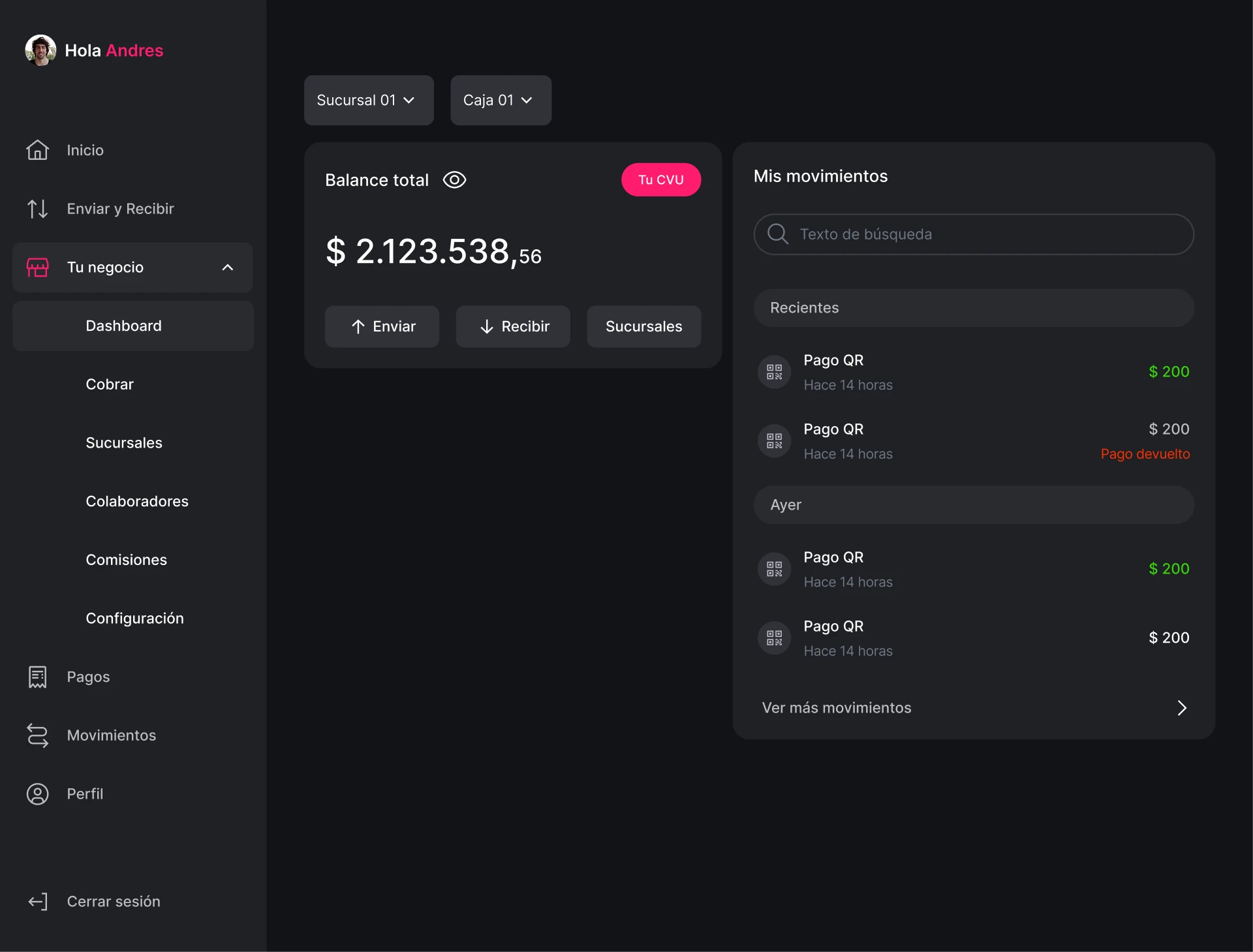
At Rebit Comercios I saw that B2B fintech design isn't about fewer features, it's about the order trust gets built in — and that trust doesn't stop at the screen. A printed QR code at a merchant's register is as much a part of the product as any onboarding flow. Building this side from zero also meant the work was never only design: it was strategy, team-building and holding steady under startup pressure, all at once.